

Posted
Sprinter vs. Ford Transit vs. RAM ProMaster: Best Van for a Camper Conversion
Forget layouts, toilets, sleeping orientation, and drivetrains... when it comes to your camper van process, picking the actual vehicle platform is the most important decision you'll make—and it happens right out of the gate. Get it right and everything downstream gets easier. Get it wrong and you're either rebuilding in three years or quietly resenting a van that never quite fit the life you had in mind. The three platforms that dominate the conversion world right now are the Mercedes Sprinter, the Ford Transit, and the RAM ProMaster. Each one has a real case to be made for it. This breakdown will help you figure out which one actually fits your needs and goals on the road. Let's dive in.
What are the key differences between the Sprinter, Transit, and ProMaster?
Before getting into specifics, it helps to understand what each van was originally built to do. The Mercedes Sprinter is a German-engineered commercial workhorse with serious global distribution and a long track record in demanding environments. The Ford Transit is an American-market van that has become the best-selling cargo van in the US for years running, with a massive dealer and parts network to match. The RAM ProMaster is a rebadged Fiat Ducato, front-wheel-drive, with a boxy interior that maximizes cargo volume. All three come in multiple roof heights and wheelbases. None of them is a bad van. But they're meaningfully different once you start putting real miles on them.
How do these three vans compare on interior space and livability?
Interior dimensions matter a lot when you're designing a full-time living space. The ProMaster wins on raw floor width. Its front-wheel-drive layout eliminates the rear differential tunnel that runs down the center of rear-wheel-drive vans, which gives you a completely flat floor from wall to wall. That's genuinely useful for a bed platform. The tradeoff is a lower cargo height compared to the Sprinter's high-roof option, and a shorter overall wheelbase at the top end.
The Transit sits in the middle on most dimensions. The high-roof extended Transit is a capable conversion platform with a reasonably flat floor (the tunnel is smaller than the Sprinter's) and excellent headroom. The interior width is competitive and Ford has done a good job of making the cargo area accessible. It's a practical van in the best sense of that word.
The Sprinter high-roof comes in two wheelbases: a 144” which is the shorter version, or a 170” extended wheelbase which is the largest interior of the three by a meaningful margin. You get more floor length, excellent standing height, and enough square footage to build a kitchen, a bathroom, a dedicated workspace, and a real bed without feeling like you're playing Tetris. If you're building for two people who plan to live in this van seriously, that extra space is not a luxury. It's functional.
Which van platform has the best off-road and four-season capability?
This is where the conversation gets decisive for a lot of buyers. The ProMaster is front-wheel-drive only. For mild weather and paved roads, that's fine. But take it down a snowy forest service road or a wet two-track and you'll find its limits quickly. There's no all-wheel-drive option available, and the low ground clearance doesn't do you any favors in technical terrain. If your van life involves mountains, snow, or any kind of serious backcountry access, the ProMaster isn't the right tool.
The Transit offers a rear-wheel-drive configuration as standard and an all-wheel-drive option that has become genuinely popular with converters who want some off-pavement capability without committing to a full overland build. The AWD Transit handles light snow and gravel roads well. It's not going to compete with a lifted 4x4 truck, but it gives you real-world confidence in marginal conditions.
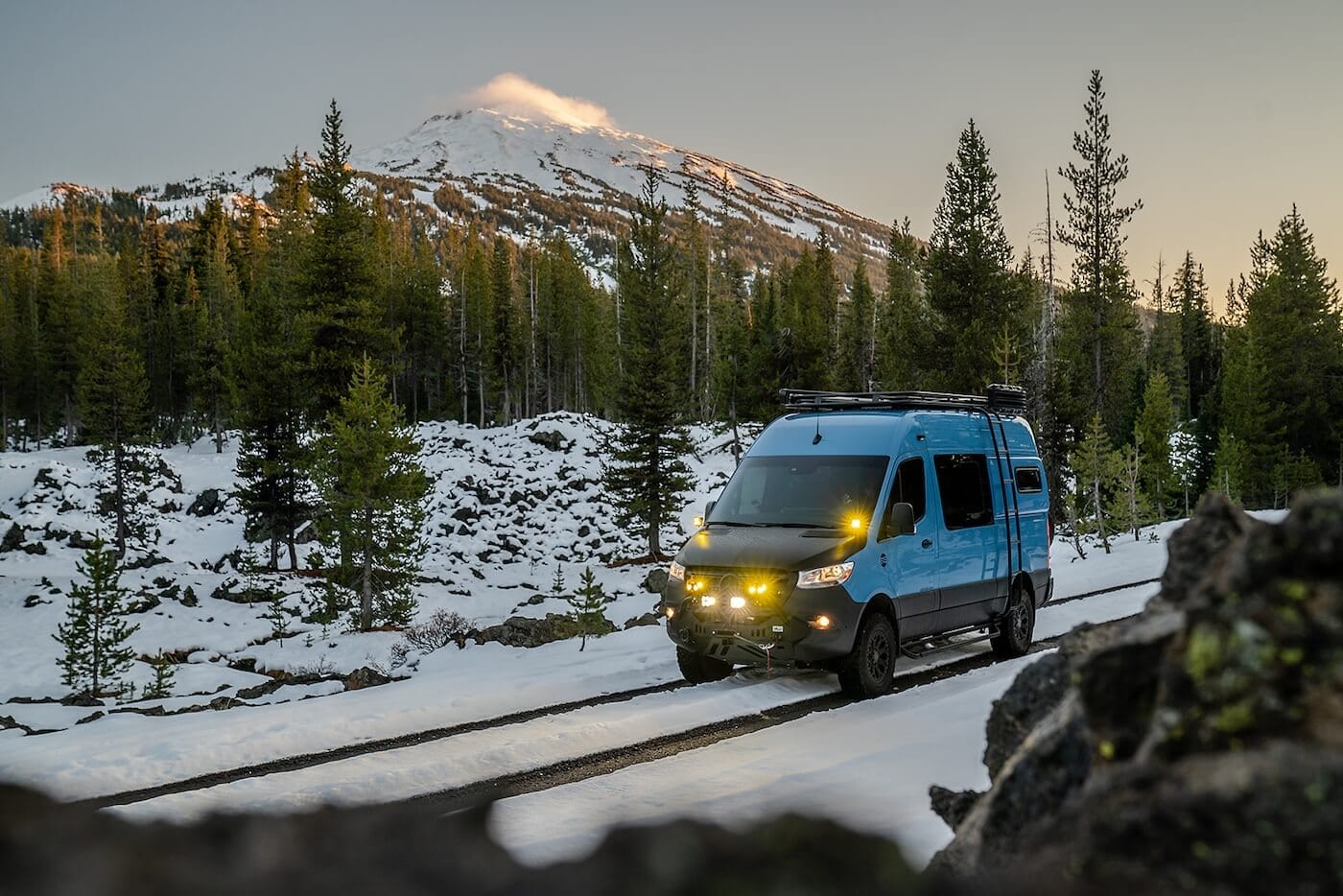
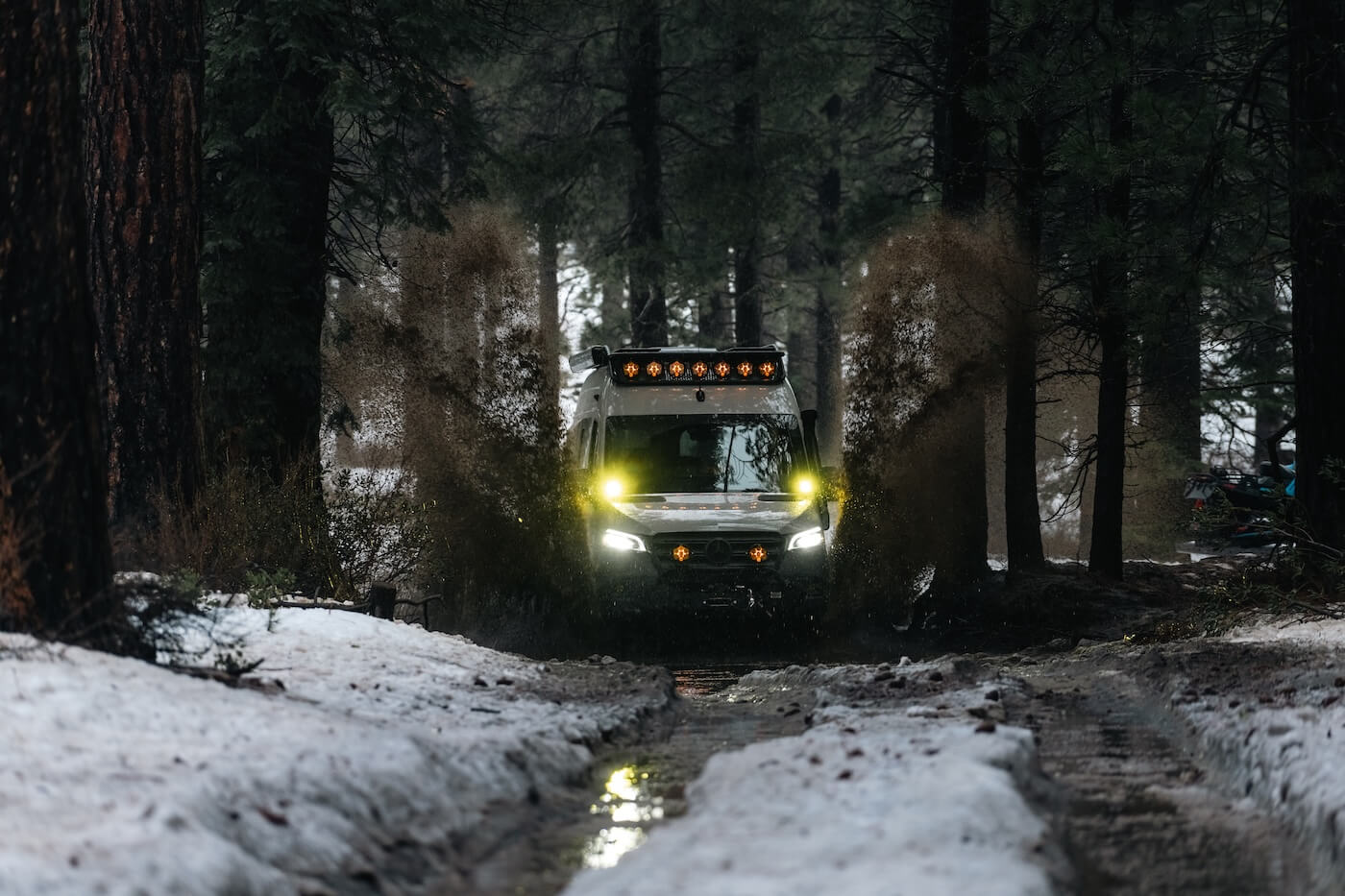
The Sprinter offers both rear-wheel-drive and a AWD option from the factory that uses a proper transfer case and low-range gearing. Combined with lifted suspension, all-terrain tires, and skid plates, a Sprinter AWD can go places that would stop most two-wheel-drive vans cold. For anyone who wants genuine access to remote campsites, ski areas, or high-altitude terrain in all four seasons, the Sprinter AWD platform is in a different category entirely.
 ×
How do costs compare across all three van platforms?
New base pricing (as of 2026) tells part of the story. A new RAM ProMaster cargo van comes in as the most affordable of the three, typically in the low-to-mid $40,000 range depending on configuration. A new Ford Transit sits in the mid-$40,000 to low-$50,000 range. A new Mercedes Sprinter starts higher, often in the $65,000 to $85,000 range for a high-roof extended wheelbase, and the AWD model adds more still.
Used market pricing follows a similar hierarchy, though Sprinters hold their value well and a clean used example with moderate miles commands a premium. Transit supply is high and pricing is competitive. ProMasters depreciate more aggressively, which is why you sometimes see them pitched as "budget-friendly" build platforms.
What those sticker prices don't account for is the total cost of the build. A serious four-season conversion with a lithium power system, quality insulation, and a well-designed interior is going to run $40,000 to $100,000+ for most RVIA certified builders for just the conversion. At that level of investment, saving $10,000 on a base vehicle that's less capable or less reliable starts to look like a false economy. The platform matters for the long haul.
What are the reliability and maintenance realities for each van?
Reliability is the thing nobody wants to talk about until something breaks on a Tuesday night three hours from the nearest town. The Ford Transit has one of the simplest and most accessible maintenance profiles of the three. Parts are everywhere, any competent mechanic can work on it, and the 3.5L EcoBoost engine has a proven record with high miles. If you're based in a rural area or plan to travel in regions without major Mercedes dealers, the Transit's serviceability is a real advantage.
The ProMaster's Fiat-derived drivetrain has a more mixed reputation. It's not unreliable, but it's also not as battle-tested at high mileage as the other two, and parts availability outside of major metro areas can be inconsistent. The front-wheel-drive system simplifies the drivetrain mechanically but adds complexity to front-end component wear over time.
Early high-mileage diesel Sprinters had some well-documented issues, particularly with AdBlue systems and certain engine variants. Newer models have addressed most of those concerns, and the 2.0L four-cylinder diesel available in current Sprinters is a capable, efficient engine. The honest caveat is that Sprinter service requires a Mercedes dealer or a specialist shop. If that's accessible to you, it's manageable. Just know what you're signing up for.
Who is each van platform actually best suited for?
The ProMaster is a reasonable choice for someone doing a weekend warrior build on a tighter budget who stays mostly on paved roads and in mild climates. The flat floor is genuinely useful and the lower buy-in price is real. It's a good starter van for someone who wants to learn the craft of building before committing to a more expensive platform.
The Ford Transit is probably the most versatile all-around choice for someone who wants capability, serviceability, and reasonable cost in one package. The AWD option expands where it can go. It's a solid, sensible platform with a huge support community and plenty of aftermarket options. There are a handful of builders who do impressive work on the Transit platform.
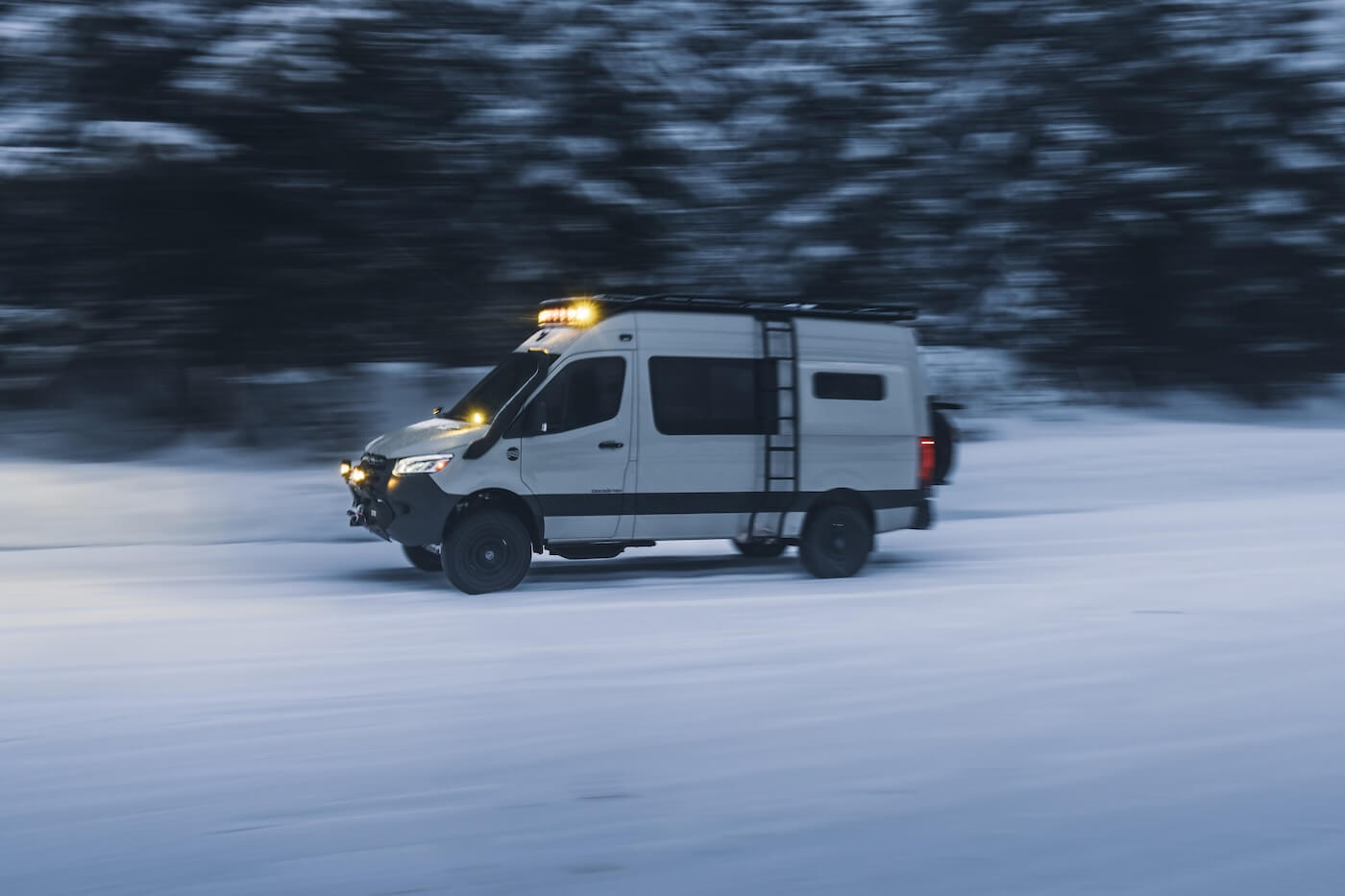
The Sprinter is the right call when you want the most interior space, genuine four-season off-road capability, and a platform that can support a serious, long-term build without compromise. It rewards investment. A well-built Sprinter with an AWD drivetrain, a properly engineered lithium power system, and high-performance insulation is a different kind of vehicle than anything you'd build on the other two platforms. It's not for everyone, and it's not the cheapest path. But for serious outdoor people who want a van that performs as hard as they do and lasts as long as they need it to, it's the clear choice.
 ×
What should you prioritize when choosing a van for a full conversion?
Start with how you actually use a van rather than how you imagine you might. If you're skiing in Colorado or mountain biking in Oregon and you want to park at the trailhead in February, you need a capable platform. If you're a remote worker who moves slowly between cities and campgrounds with hookups, the calculus is different. Be honest about the terrain you'll actually drive, the seasons you'll actually camp in, and the number of people who'll actually live in it. Those answers will point you toward the right platform more reliably than any spec sheet.
Interior size, off-road capability, reliability in your specific context, and total cost of ownership over five to ten years are the variables that matter most. The van that costs the least to buy is rarely the van that costs the least to own and build well.
At Cascade Van, we build exclusively on the Mercedes Sprinter platform, and that decision is intentional. Based in Bend, Oregon, we work with serious outdoor people, skiers, mountain bikers, and remote workers who need a van that performs in real conditions year-round. Our builds are RVIA-certified, which means they meet established safety and quality standards that matter when you're living in a vehicle full-time. We use advanced lithium power systems, high-performance four-season insulation, and refined interior layouts designed for the way people actually live on the road. Whether you're a solo traveler who needs a smart, efficient layout or a couple who wants a full kitchen and a comfortable workspace, we build to that exact brief. If you've done the research and you know a Sprinter is the right platform for your life, we'd love to talk about what your build looks like. Reach out to the Cascade Van team and let's start the conversation.