

Posted
Best Floor Plans for a Sprinter Camper Van: 2-Person, Family, and Adventure Builds
Choosing a floor plan is the most important decision in a Sprinter build. Get it right and your van feels like a well-designed studio apartment on wheels. Get it wrong and you're constantly working around your own space, moving gear to find other gear, and wishing you'd thought harder about where the toilet goes. The layout touches everything: how well you sleep, how easily you cook, how much you can carry, and whether two people can exist in 80 square feet without wanting to open the side door and walk away forever.
This guide breaks down the most practical and most searched Sprinter floor plan configurations for 2026, matched to the types of trips and travelers they actually suit. Whether you're planning a solo remote work setup, a two-person ski and bike rig, or a family build that needs to sleep four, there's a layout here worth understanding in detail before you commit.
What are the most common Sprinter camper van floor plan categories?
Most Sprinter builds fall into a handful of core configurations, and each one solves a different set of problems. The three categories that matter most are two-person layouts, family layouts, and what builders call adventure or full-time builds. Within each of those, you'll find variations driven by the van's wheelbase, the placement of the bed, galley size, seating, and storage strategy. Understanding the categories before you get into specific layouts keeps you from falling in love with a build that doesn't fit your life.
The 144-inch wheelbase Sprinter is the most common starting point. It's maneuverable enough to park in a normal campsite, fits in most parking spaces, and still gives you enough room to build a genuinely functional living area. The 170-inch extended wheelbase opens up a lot more real estate and is the go-to choice for full-timers or families who need serious square footage. Both wheelbases are available with high roofs, which is essentially non-negotiable for anyone who wants to stand up comfortably.
Which floor plans work best for two people?
For couples or two-person travel, the priorities are almost always the same: a comfortable fixed bed, a real kitchen, and enough storage that you're not living out of bags piled on the floor. The debate usually comes down to where the bed sits (rear, side, or garage-style) and how much you're willing to sacrifice in one area to gain in another.
A rear fixed bed running side to side is the most space-efficient option for a 144-inch van. It gives you full-width sleeping without eating up floor space during the day, and it keeps the galley and seating at the front of the living area where you actually use them. The tradeoff is that one person has to climb over the other to get out, which matters more on long trips than people expect before they've done one.
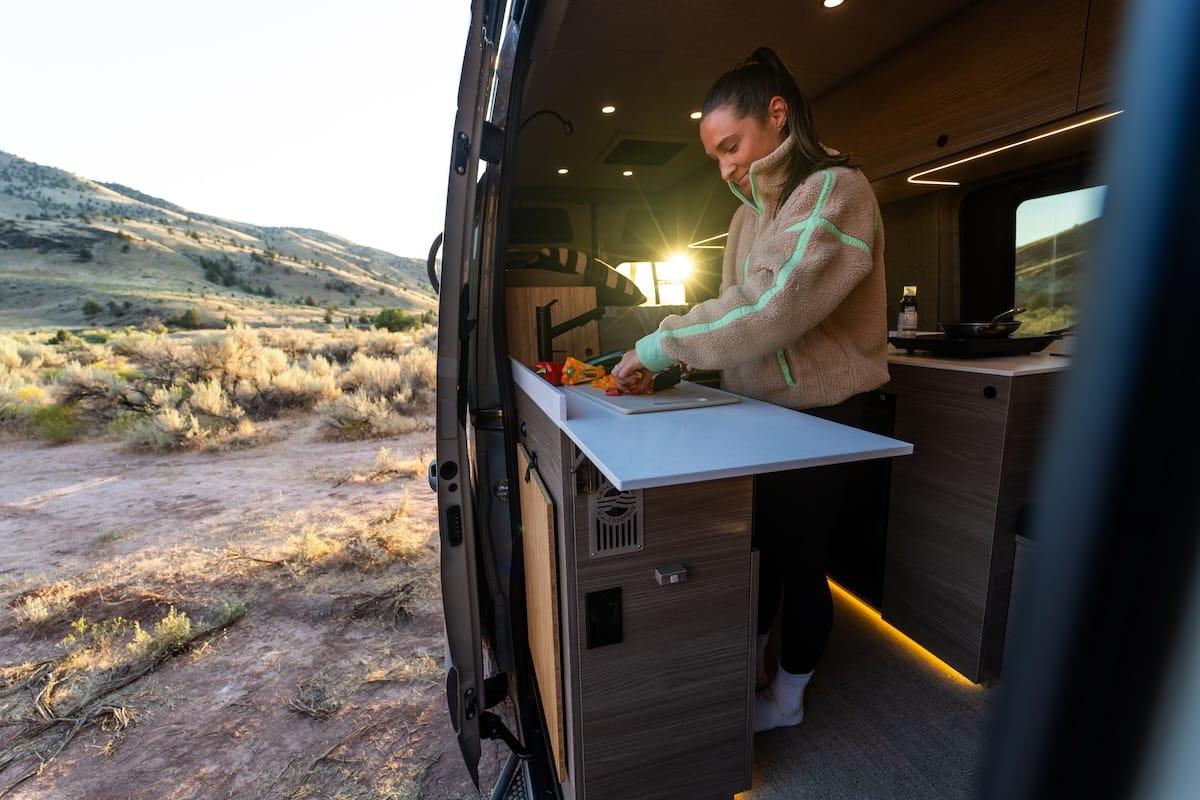
The Cascade Van Funner is a strong example of what a well-executed two-person 144-inch layout looks like in practice. It features dual benches that convert into a micro dinette, optimized storage throughout, and a design that balances function with the kind of interior you actually want to spend time in. It starts at $110,500 and it's one of their most popular floor plans for good reason. Everything has a place, and nothing feels like an afterthought.
For two-person travelers who want more room, especially those who spend extended stretches on the road, the 170-inch Mt. Bachelor is the longer evolution of that same concept. It carries Cascade Van's largest galley, the most generous bed configuration they build, and storage that genuinely accommodates full-time living. Starting at $122,500, it's the layout for people who've done a few trips in a smaller van and know exactly what they wish they had more of.
What floor plan should a family of four consider?
Families bring a specific set of constraints that solo travelers and couples don't have to think about: two kids who need real sleeping space, gear for four people doing active things, and a floor plan that can flex as the kids get bigger and the trips get more ambitious. A layout that works great for a weekend ski trip with a seven-year-old needs to still work when that kid is twelve and has their own gear opinions.
The Cloudchaser on the 144-inch platform is built for exactly this scenario. It seats and sleeps up to four, with a second-row seat that swivels and folds flat into a bed for one or two kids, and it can be ordered in a "Lounge" configuration that swaps that seat for a 40" bench when you're traveling as a couple. You can also add an internal-access pop-top or a rooftop tent to expand sleeping quarters up top, which is what makes the four-person math work without crowding the main cabin. Pricing starts between $122,500 and $127,500 depending on configuration.
Cascade Van's Summit Series takes a slightly different approach. It's a family-of-four layout that's deliberately feature-light, which means it keeps the price more accessible (starting at $88,500) while still delivering the core functionality families need for weekend use. It's not stripped down in a way that feels cheap; it's just focused. If your use case is weekend getaways rather than month-long expeditions, this is often the smarter financial decision.
The Pine Drop and Little Drop deserve a mention here because they're the most configurable layouts in Cascade Van's 144-inch lineup. Need a third sleeping spot? More kitchen counter space? A layout that can seat an extra person? The Pine Drop family handles all of it, seating and sleeping up to three, starting between $97,500 and $107,500. It's a strong choice for a smaller family or a couple who wants flexibility, though families who specifically need to sleep four should look at the Summit Series or, on the longer platform, the Mt. Hood.
For families who want the most capable build available, the 170-inch Mt. Hood is the flagship family layout. It features removable and adjustable bunk-style sleeping quarters, a stowaway second row of seats, and a floor plan designed to evolve with your family over time. Soccer weekends, cross-country road trips, ski season—it handles all of it without requiring you to compromise in any one direction. It starts at $132,500.
How does the wheelbase affect which floor plan is right for you?
The 144-inch Sprinter gives you a van that's genuinely easy to drive and park anywhere. Forest roads, tight campgrounds, downtown parking spots—none of them become a problem. The 170-inch extended wheelbase gives you significantly more floor space, but you trade some of that flexibility for it. It's a real tradeoff, not just a theoretical one. If you do a lot of dispersed camping on tight two-track roads, the shorter van will open up spots the extended can't reach.
That said, the extended wheelbase is the right call for full-time van lifers and families who genuinely need the room. The extra length translates directly into a larger galley, a more comfortable bed configuration, and storage that doesn't require you to think like a ship's captain every time you pack for a trip. Most people who go with the extended version and spend real time in it don't look back.
What features should every Sprinter floor plan include regardless of layout?
Some things aren't layout-specific. They're baseline requirements for any van that's going to perform in real conditions across multiple seasons. Insulation is at the top of that list. A well-insulated van with a quality heating system is the difference between a comfortable night in the mountains and a miserable one. Lithium power systems have become the standard for serious builds because they're lighter, charge faster, and handle deep discharge cycles far better than AGM batteries. A van without a capable electrical system is a van that limits where you can go and how long you can stay.
Cascade Van builds every layout with four-season capability as a baseline, not an upgrade. That means advanced lithium power systems, high-performance insulation, and systems designed to function reliably in the kind of conditions that serious outdoor travelers actually encounter. It's not marketing language; it's the practical result of building vans for people who ski in the Cascades, mountain bike in the desert, and work remotely from places where the nearest town is an hour away.
How do you choose between a fixed bed and a convertible sleeping setup?
Fixed beds win on convenience every single time. You don't have to convert anything to sleep. You get in, you go to sleep. That sounds simple, but after three weeks on the road it becomes genuinely important. Convertible setups make sense when you need the daytime floor space more than you value the nighttime convenience, or when you're building for a use case where sleeping is always an afterthought to seating capacity.
For most two-person and solo builds, a fixed rear or side bed is the right call. For families who need flexible seating and sleeping arrangements, a convertible or split setup with a pop-top makes more practical sense. The best layouts don't force you to choose between comfort and function—they find the configuration where you don't have to give up either.
What should you know before committing to a custom Sprinter build?
Custom builds take time. A quality conversion from a reputable builder runs several months from deposit to delivery, sometimes longer depending on the shop's schedule and the complexity of the build. That's not a problem—it's the cost of getting something built right. What it means is that if you have a specific trip in mind, you need to plan well ahead. It also means you have time to think carefully about your floor plan before the build starts, which is exactly the kind of time you should use.
Working with an RVIA-certified builder matters more than most people realize until they try to insure or resell a van built by someone without that certification. It's an industry credential that requires the builder to meet specific safety and construction standards, and it gives you meaningful protection as a buyer. Not every shop has it. The ones that do have generally done the work to earn it.
The best floor plan isn't the most expensive one or the one with the most features. It's the one that fits how you actually travel, what you actually need, and where you actually go. That answer is different for every person reading this, and getting it right is the whole point of the exercise.
Ready to build your ideal Sprinter van? We're Cascade Van, an RVIA-certified custom camper van builder based in Bend, Oregon, and we specialize exclusively in luxury, off-grid Mercedes Sprinter conversions built for people who take their adventures seriously. Whether you're a couple chasing ski seasons, a family that wants a rig that grows with you, or a remote worker who needs a mobile base that doesn't compromise on comfort or capability, we have a floor plan and a build process designed for exactly that. Our four-season builds combine advanced lithium power systems, high-performance insulation, and refined modern interiors into vans that work as hard as the people driving them. Reach out to our team in Bend to start the conversation about your build.